Ogre-Engineering Mass Combat
Or: how hard should a stand of ogres hit, and how much should it take to kill?
In my (current) design for Mass Combat FOEGYG uses one base size. One regiment per stand, one footprint for every unit on the table. I made this choice because this allows for faster adjudication; rank-and-flank is always fiddly; too many models to scoot about, you need unit trays to keep your sanity and it just all gets harder to handle. But that's beside the point. The point of this post is a problem that the decision creates.
If every stand is the same size, then a stand of ogres and a stand of men occupy the same rectangle of table. Whatever it means for an ogre to be an ogre (on the field of combat: that it hits harder than a man and takes more to put down) has to live entirely in the statline. And for FOEGYG, I want to have a single statline for individuals that applies to all; man-to-man, skirmish and mass combat.
Which makes for an interesting problem statement: how do hitting power and staying power of a full unit of ogres from the statblock of an individual Ogre?
Illustrating the problem (colourized)
Here's the trap, in one picture. This is the schema I started out with. A hypothetical ogre that takes up the space of four men1:
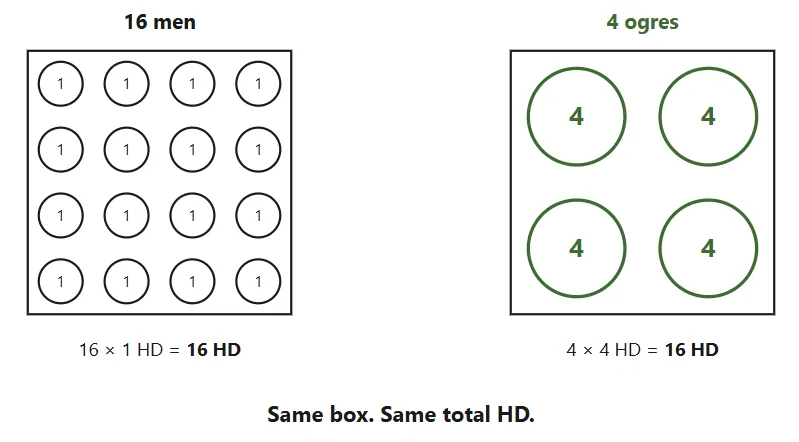
If an ogre is worth four men, four hit dice, fights as four men, whatever your equivalence, then a stand of ogres that fills the same footprint as sixteen men contains four ogres, and four ogres of four HD each is sixteen HD. It's clean, it's simple. Job done, time to go drink a beer and congratulate ourselves.
But you have not done a job well done. Because "sixteen HD of ogres" and "sixteen HD of men" are not the same thing on the table, and the difference is the whole subject of this post. Hitting power and staying power do not scale the same way when you hold the footprint fixed, and if you let them scale by accident you will get a result that feels wrong to everyone at the table without anyone being able to say why.
Let me show you the math, because for once I think that'll make the issue clear:
The caveats before the math
A handful of things I'm assuming, so nobody has to type them at me later.
This is an argument about averages. Everything below runs on the law of large numbers: it describes what a stand tends to do over many combats, not what any single clash will produce. Take twelve men against two ogres and the dice can hand you an afternoon that looks nothing like the averages I derive here. That's fine; that's variance, and variance is the name of the game. The scaling math is for setting the baseline the dice then swing around, not for predicting any one result.
I'm stripping every special rule. Big things in most systems come freighted with terror, regeneration, oversized-weapon bonus dice, throw-a-boulder, fall-over-when-they-die, and a dozen other bolt-ons. All of it is off the table here. I'm comparing raw hitting power against raw staying power, because that's the only way to see the scaling cleanly. Of course we'll bolt special rules back onto our Ogre's gut plates before sending them into the field, but for our baseline we're leaving them off.
Hitting power and staying power are single numbers. When I say H, I'm folding attacks, chance to hit, and damage-per-hit all into one scalar: "how much damage this thing tends to deal." The model doesn't care whether an ogre's punch is one big swing or three little ones, especially not at the mass combat scale. The same argument for staying power. I'm ignoring armor and anything else that'll make a monster tougher. All of those rules apply equally to men and monsters anyhow.
Bases are square, and depth is constant. I know that some systems love their rectangular horses. But for ease of math, I'm assuming every monster on the table takes up a square area. Overall it shouldn't matter to the arguments I make, but it makes the math cleaner and therefore more true. On a related note: for hitting power, I'm also assuming that both men and ogres have the same number of ranks that contribute to hitting power.
We're ignoring morale for the moment. It's downstream of staying power, and generally the thresholds scale with hit dice about linearly anyway.
What's left, once you've stripped all that out, is a spherical large-scale combat in a vacuum.
The math
Two definitions. For any unit x, let F[x] be its frontage: the width of one figure, measured in men. A man has F = 1. H[x] is the raw hitting power of your monster, and S[x] its raw staying power.
Now the two quantities we actually care about, each normalised against the men who would occupy the same footprint:
- nH[x] = H[x] / F[x] — normalised hitting power. How hard a stand of these hits, per the frontage it occupies.
- nS[x] = S[x] / F[x]² — normalised staying power. How much punishment a stand of these soaks, per the area it occupies.
The two denominators are different. Hitting power divides by frontage. Staying power divides by frontage squared.
A battle line is one-dimensional. What matters for how much damage a stand deals is how much of it can reach the enemy; the width of the contact edge. Widen a creature and you fit fewer of them along that edge, in direct proportion. Frontage is linear, so hitting power scales with F. This is easily visible in the men vs ogre image; Ogres have 2 figures in the front, half, compared to the man's quarter.
But a footprint is two-dimensional. When you ask how many men's worth of bodies fit in the rectangle an ogre stands in, you're asking about area, and area goes as the square of the width. So staying power scales with the square inverse of man-relative frontage.
Two immediate conclusions you can draw from this:
Big monsters are always hittier than they are tanky, per footprint. Since F > 1 for anything bigger than a man, and since dividing by F² bites harder than dividing by F, nH always exceeds nS. A stand of big monsters brings more punch-per-frontage than durability-per-area. The bigger the monster, the wider the gap.
Small things flip it. For anything with F < 1, your hobbits, your sprites, the squaring works in their favour, and they become comparatively tankier per footprint than they are hitty. A stand of hobbits is a surprisingly durable speed-bump for its width.
And the sharp one, the trap I almost fell into myself: if you assume hitting and staying power both track hit dice, the assumption "an ogre is N men" equivalence extends to how much space they take up (as in the picture: 4 ogres take up as much space as 16 men), a unit of ogres isn't any tankier than a unit of men.
More generally: a stand of monsters is tankier than the men it displaces only when F < √HD. Base your ogre any wider than the square root of its hit dice, and a footprint of ogres soaks less than the same footprint of men. You will have built a big scary monster that a unit of spearmen out-survives.
And although I did all of this ogre-engineering just to figure out some stuff for an elf game for people too lazy to get multiple sizes of cubes, it also applies to people who do have multiple sizes of cubes. Even if you're playing Chainmail, Swords and Spells, or anything else, these guidelines hold.
Looking at other systems
I've picked a few systems I've looked into in the past and see how their men, ogres and giants line up roughly. I've plotted these as a function of nS vs nH. I've also the area nH and nS > 1 green. This is the zone where monsters hit harder and are tougher than men.
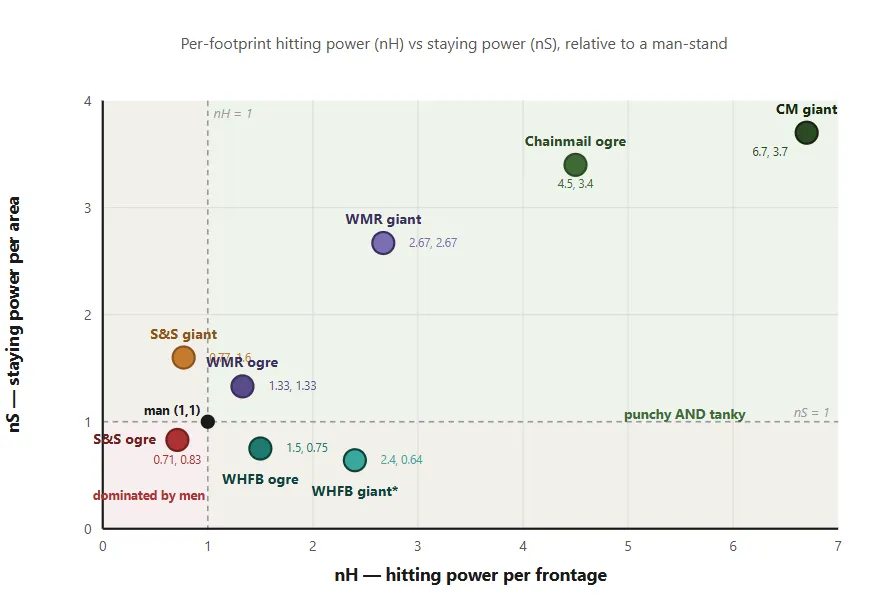
Chainmail flings its monsters into the top-right corner and keeps going. The ogre lands at roughly as punchy and tanky, the giant further out still; lavishly punchy, lavishly tanky, more so the bigger they get. Gygax based his monsters tight: an ogre fights as six heavy foot and dies to six hits, but sits on a base only a third again as wide as a man. All that combat power, compressed into barely more frontage, has nowhere to go but up. Chainmail monsters are per-footprint monsters in every sense.
Swords & Spells: same designer, a few years later, does almost the opposite. It widens the bases and, crucially, decouples damage from hit dice: staying power still climbs with HD, but damage is a coarse bracket that barely moves. The ogre falls through the floor to: a stand of S&S ogres is worse than the men it displaces at both hitting and surviving. The giant does better on staying power alone, buoyed by raw hit dice, but still can't out-punch a man per frontage. In the S&S world, truly, men are the real monsters.
Warmaster keeps one base for nearly everything and puts the monster's bulk entirely in the statline2. And since base size is the same, the higher attacks and hits than men make ogres land smack in the green and the giant marches further into it3.
Warhammer Fantasy Battles gives its monsters big bases but only modest wound counts, and pays for it. Both are punchy per frontage and fragile per area; below the diagonal, below parity on staying power. The big base absorbs the frontage, but the wounds don't keep pace with the squared denominator, so durability-per-area leaks away. A WHFB monster is a hammer with a glass jaw.
Like I said: this is not a single-base-size problem. Chainmail, S&S, and WHFB all have multiple base sizes, and all three let relative hitting and staying power emerge from the basing. And they effectively go three different directions. WHFB has them do more damage, but be less tanky, while S&S makes them barely more tanky than men while doing fewer hits per frontage. Meanwhile, the Chad Gygax of Olden Days decrees: 'Let Monsters Be Scary', and makes his Ogres and Giants swat men aside like flies while laughing at the spears sticking into their thick hides.
Where monsters ought to be
I'm going to take a hard line in this: whatever you do, and however you do it, you should expect your big monsters to land in the green. Punchier and tankier than an equal footprint of men.
A single ogre hits harder than a single man and takes more to kill; that's what "ogre" means. If a unit of them somehow doesn't preserve that, if a stand of ogres hits like a stand of men, or dies like one, it reads as bad design even to players who couldn't tell you the math. The individual creature sets an expectation, and the mass version has to honour it or feel broken. It's fine to scale it down a bit; that's what separates the men-to-men from the mass combats, but even so: a regiment of giants should in all physical aspects outperform a unit of men.
And frankly, you can't even price your way out of this issue. If you tried to compensate for the weaker hitting power per frontage or staying power per area, you wouldn't make them scary again. You'd be balancing Ogres as a budget option for those who didn't have access to the obviously superior men-type troops. In effect, you'd be turning Ogres into a horde army. Arguably a hilarious inversion, but one that goes against all fiction and all wargames ever. It's a dead end from the start.
Giants, ogres, trolls are the things a fantasy army fields to be scary. If your Giants hit a line of men and consistently lose, you have designed your game wrong. Even if you show me the math of how it's right, you're still wrong. It goes against the fiction and therefore fails the most important test.
A guideline
So if you believe my math, here is a rough guideline for scaling larger monsters to a man-equivalent frontage.
| Size | Frontage | Hitting power | Staying power |
|---|---|---|---|
| Man-sized | 1 | ×1 (unchanged) | ×1 (unchanged) |
| Ogre-sized (4+ HD) | ~1.5 | ×⅔ of individual | ×½ of individual |
| Giant-sized (8+ HD) | ~2 | ×½ of individual | ×¼ of individual |
Read it as: take the creature's individual hitting and staying power (as always: compared to a man), and scale them down to what one stand's footprint should carry. Big monsters hit hard and soak hits, more of both than the men they push aside. Which is, when you stand back from it, exactly what an ogre was always supposed to be.
So until next time, count your torches man-equivalents and keep mapping!
Footnotes
Note: this is a hypothetical, ahistoric Ogre I constructed while looking at the problem. As Purple Druid pointed out to me: Chainmail Ogres fight as 6 men and only take up 1.5 man-widths. I left this example because it's nice and neat.↩
Which is to say, it does what FOEGYG will have to do too.↩
Technically, since Warmaster Giants are based short-edge instead of long-edge like any other monster, it really should have double the hitting power shown here, but I only realized late in the process of writing and it doesn't really qualitatively alter my findings so I left it as is.↩